Catalogs
The simulator takes catalogs describing objects in a scene and generates images of that scene. These catalogs have the following form:
   ra     dec   type    n    half_light_radius    pa      ba     F087
float64 float64 str3 float64      float64      float64 float64 float64
------- ------- ---- ------- ----------------- ------- ------- --------
  269.9    66.0  SER     1.6               0.6   165.6     0.9 1.80e-09
  270.1    66.0  SER     3.6               0.4    71.5     0.7 3.35e-09
  269.8    66.0  PSF    -1.0               0.0     0.0     1.0 2.97e-10
  269.9    66.0  SER     2.5               0.8   308.8     0.7 1.50e-09
  269.8    65.9  SER     3.9               0.9   210.0     0.9 3.28e-10
  270.1    66.0  SER     4.0               1.1   225.1     1.0 1.61e-09
  269.9    65.9  SER     1.5               0.3   271.8     0.6 1.13e-09
  269.9    65.9  SER     2.9               2.3    27.6     1.0 3.28e-09
  269.9    66.0  SER     1.1               0.3     4.3     1.0 9.99e-10
The following fields must be specified for each source:
ra: the right ascension of the source
dec: the declination of the source
type: PSF or SER; whether the source is a point source or Sersic galaxy
n: the Sersic index of the source. This value is ignored if the source is a point source.
half_light_radius: the half light radius of the source in arcseconds. This value is ignored if the source is a point source.
pa: the position angle of the source, in degrees east of north. This value is ignored if the source is a point source.
ba: the minor-to-major axis ratio. This value is ignored if the source is a point source.
Following these required fields is a series of columns giving the fluxes of the the sources in “maggies”; the AB magnitude of the source is given by \(-2.5*\log_{10}(\mathrm{flux})\). In order to simulate a scene in a given bandpass, a column with the name of that bandpass must be present giving the total fluxes of the sources. Many flux columns may be present, and other columns may also be present but will be ignored.
The simulator then renders these images in the scene and produces the simulated L1 or L2 images.
The simulator API includes a few simple tools to generate parametric distributions of stars and galaxies.
The make_stars and make_galaxies routines make random catalogs of stars and galaxies. The number of stars and galaxies can be adjusted. Likewise, the power law index by which the sources’ magnitudes are sampled can be adjusted, as can their limiting magnitudes. Galaxy Sersic parameters, half-light radii, and position angles are chosen at random, with a rough attempt to make brighter galaxies appropriately larger (i.e., conserving surface brightness). Stars can be chosen to be distributed with a King profile. This functionality is however very rudimentary and limited, and is better suited for toy problems than real scientific work.
We expect scientific uses to be driven by custom-created catalogs rather than the simple routines above. The routines make_cosmos_galaxies and make_gaia_stars outlined below provide some more scientific realism and may be adequate for some use cases.
Using COSMOS Galaxies and GAIA Stars
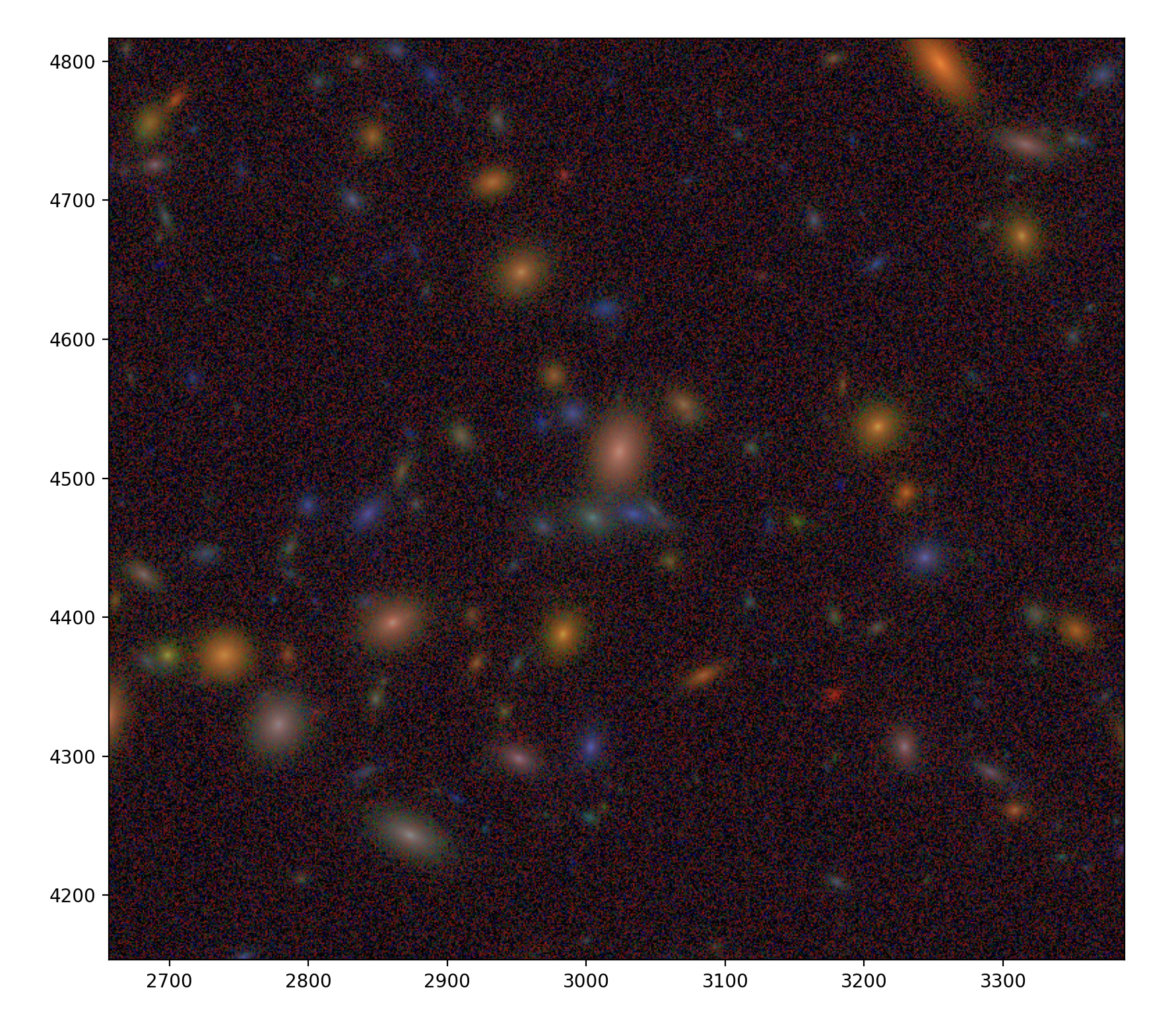
Level 3 Mosaic of cosmos sources
The simulator can utilize the COSMOS catalog to generate sources based off of real galaxies via the make_cosmos_galaxies method. The COSMOS survey is a 2 square degree collection of over 2 million galaxies with multi-wavelength photometry (Weaver et al. 2022)[https://arxiv.org/pdf/2110.13923]. A streamlined catalog for the simulator is provided with the code, but for those so interested, the latest full catalog can be found at https://cosmos.astro.caltech.edu/ and used with this method.
The simulator performs the following operations on the catalog sources:
Only galaxies that have “ultra-deep” Ultra Vista wavelength measurements are selected from the COSMOS catalog. This trims the catalog to 0.62 square degrees, and to a peak magnitude depth of ~25.
The source density of the COSMOS catalog as well as the input viewing area are used to determine the number of sources simulated.
Roman bands are approximated by linear interpolations of nearest HST and Ultra Vista bands.
Galaxies are placed in random positions about the sky.
While galaxy sizes and ellipticities are preserved, they are given randomly chosen concentrations (1 <= n <= 4), and detailed shape information is ignored.
Sources are randomly oriented.
Source fluxes and colors are lightly perturbed.
The simulator allows for passage of a user-specified COSMOS file (one which must have the same tabular format as COSMOS2020_CLASSIC_R1_v2.2_p3.fits) via the filename keyword. The catalog area can be set with cat_area.
The simulator can also generate place Gaia stars at the appropriate locations using the make_gaia_stars method, in place of the random stars in make_stars. Note that these stars have fluxes exactly equal to the Gaia G band fluxes in all bands; i.e., no attempt is made to predict accurate colors of stars.
romanisim.catalog Module
Catalog generation and reading routines.
This module provides basic routines to allow romanisim to render scenes based on catalogs of sources in those scenes.
Functions
|
Read an astropy Table into a list of CatalogObjects. |
|
Make a catalog of galaxies from sources in the COSMOS catalog. |
|
Make a dummy catalog for testing purposes. |
|
Make a dummy table catalog. |
|
Make a catalog of stars from the Gaia catalog. |
|
Make a simple parametric catalog of galaxies. |
|
Construct a RealGalaxyCatalog from a list of image filenames. |
|
Make a simple parametric catalog of stars. |
|
Read a catalog (or directory of catalogs) into a list of CatalogObjects. |
|
Make a catalog of stars from a Gaia catalog files, sorted by Healpix. |
|
Read an astropy Table into a list of CatalogObjects. |
Classes
|
Simple class to hold galsim positions and profiles of objects. |
Class Inheritance Diagram
romanisim.gaia Module
Functions
|
Convert Gaia output to a catalog of locations for input to romanisim. |